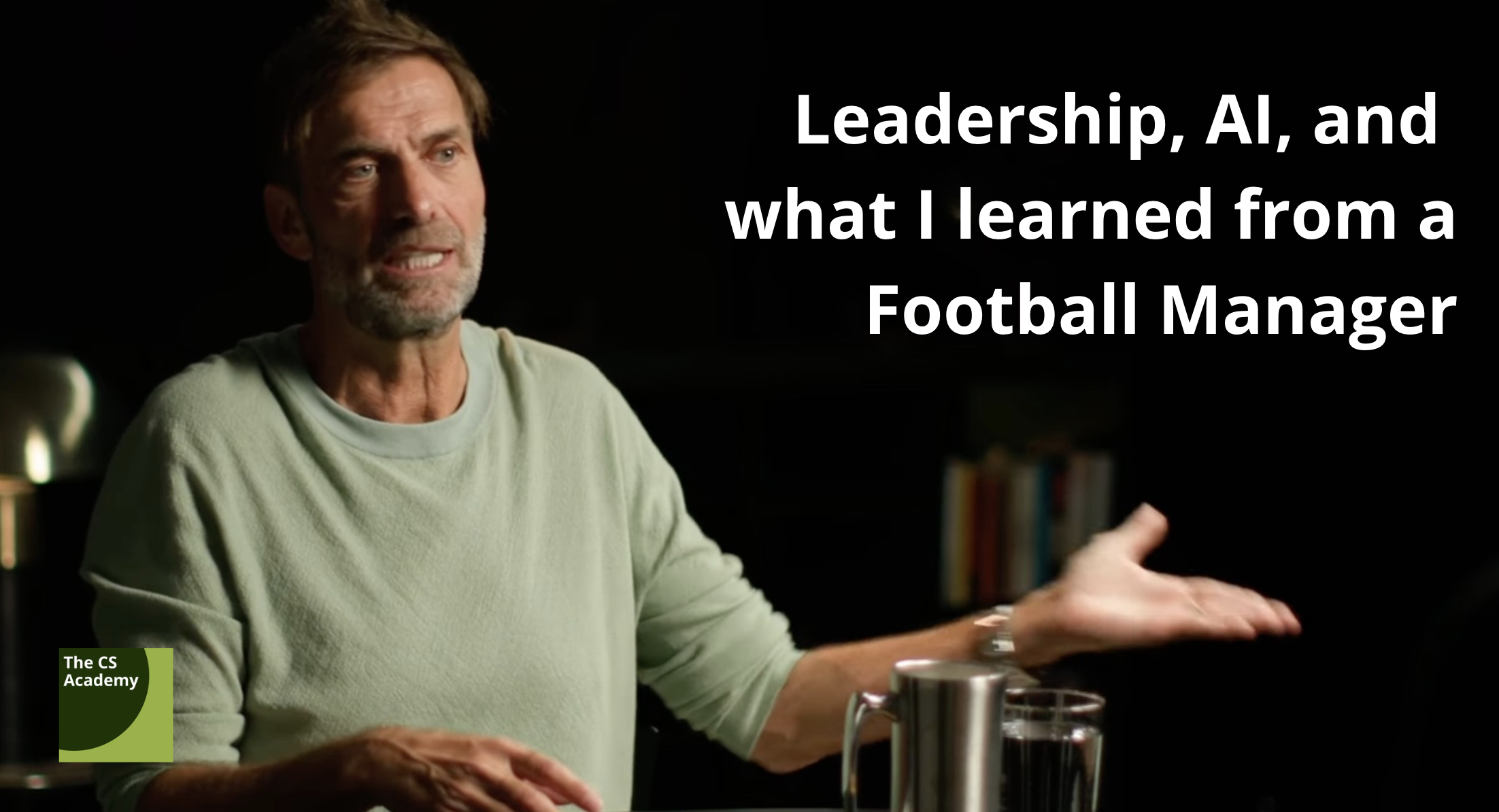
I'll be honest. I’m German, and I have never been a football fan. It’s just not my world. I’ve also rarely seen Germans take the international stage and become the kind of globally acknowledged, charismatic leader that people truly want to follow.
Then, I stumbled across a two-hour, 30-minute podcast episode with Steven Bartlett and Jürgen Klopp.
I wasn't listening to a football manager. I was listening to one of the most profound, people-centric leaders I've ever heard.
What struck me, going deep into his philosophy, wasn't his tactics for winning a game. It was his tactics for building a team. And I realised his principles aren't just applicable to leadership—they are the exact playbook we need to navigate the complexity of 2026.
The "Bespoke Leader": Treating People Differently
Klopp's core philosophy is radical in its simplicity: You must treat people differently to treat them fairly.
He said, "Everybody has a story to tell," and leadership means being "super curious" about that story. He spoke about how you can't manage a player from Argentina who "grew up without a window" the same way you manage a player from Munich, where "everything was fine."
His goal is to "really pick the individual from where it stands, not from where you want it to be."
Think about that for a moment. How often in business are we told to be "consistent," to apply the same rules and processes to everyone? Now, apply Klopp's logic to our world: implementing AI.
As we roll out new AI tools—be it a co-pilot for CSMs, an AI-driven health score, or automated support channels—our teams are not a monolith. - You have your "star player" who is terrified this new tech will make them obsolete.
- You have your new hire, who is excited and sees it as a way to learn faster.
- You have your sceptic who believes "it will never understand our customers' nuance."
A traditional leader sends a memo, runs a one-size-fits-all training, and demands adoption. The team’s "performance" (adoption) suffers, and the leader scolds them.
A Klopp-style leader does the opposite. They get curious. They find out the root cause of the resistance. - To the terrified CSM, they don't scold; they support. They frame AI as the tool that will free them from low-value tasks to focus on the high-value strategic relationships only a human can build.
- To the sceptic, they listen and validate their concerns, turning them into a partner: "You're right, it's not perfect. Help me find the gaps. Let's test it on this segment and see where it breaks."
This isn't just management; it's bespoke leadership. It’s meeting people where they are, not where we wish they were.
Building the "Internal World" in an Age of Firefighting
Klopp's second principle is creating a community willing to "walk through fire" together. He does this by building an "internal world" at the club that is "more important than the outside world." He ensures his team gets the real story from him, not from the noise of social media or the press.
In Customer Success, our "outside world" is a storm of firefighting. It’s the escalation, the renewal that’s suddenly at risk, the budget cuts from finance, and the constant, deafening headlines about AI replacing our function.
This external noise breeds fear and isolation.
A leader's job is to make the internal world—the culture of your team—stronger than that noise. It's about showing the same respect to your support agents and renewal specialists as you do to your top CSMs. It's creating a "vibe," as Klopp calls it, where the team realises their collective goal is special and "worth it."
When your team trusts each other and their leader more than they fear the external chaos, firefighting stops being a panic and starts being a shared mission.
From "Constant Winner" to "Constant Tryer"
This brings me to a personal note.
There’s a punchline to this story. Jürgen Klopp and I are both German. We both found ourselves on the international stage, leading teams. And we both fundamentally believe that empathy and authenticity are the only ways to lead.
But leadership isn't just about how you manage a team; it's about how you manage yourself and I talk a lot about sel
Klopp has a brilliant mindset for failure. He says he doesn't see himself as a "constant winner" but as a "constant tryer." When you lose, you learn. If you don't learn, it's just a defeat. If you do, it's "very, very important information."
I recently had my own moment of "managing a setback." As many of you know, I am currently looking for my next leadership role. A few weeks ago, I posted on LinkedIn that I was #opentowork.
To be completely honest, I hesitated for two weeks. I thought it looked "desperate and silly."
But I decided to be a "constant tryer" and embrace vulnerability. I put up the green banner and shared my story.
The post reached over 55,000 people. The wave of support, introductions, and encouragement was one of the most incredible things I've experienced.
What I learned, and what Klopp’s philosophy confirms, is that: - Vulnerability is a Superpower: Being open doesn't look desperate; it looks courageous. It invites your community in.
- Community is Your Catapult: We are not meant to do this alone. As leaders, we need to build communities, and we also need to lean on them.
Leading in 2026
As we head into this new year, the greatest challenge for leaders won't be understanding the technology of AI. It will be understanding the psychology of the people implementing it.
The future of leadership doesn't belong to the best technologist or the strictest manager. It belongs to the "bespoke leader." It belongs to the "constant tryer." It belongs to the leader who is curious enough to listen, human enough to be vulnerable, and brave enough to build a community that can weather any fire.
We don't need to be football fans to learn from this. We just need to be human.
P.S. My journey to find my next "squad" continues. I am looking for a senior leadership role in Customer Success or Account Management where I can build and scale a world-class, people-first team.
If you're a leader who shares these values, or you know a company that needs someone to bring it all together, I’d be truly grateful for a conversation. You can find me right here on LinkedIn.
Thank you. |